Why Putting a Full vCard on an NFC Chip Breaks iPhone Tap-to-Open (NTAG216 Memory Breakdown)
In this article
When people first look into NFC business cards, a natural engineering question comes up: why does the chip store a web link that opens a profile page, instead of storing your entire .vcf contact card directly inside the silicon so it works completely offline?
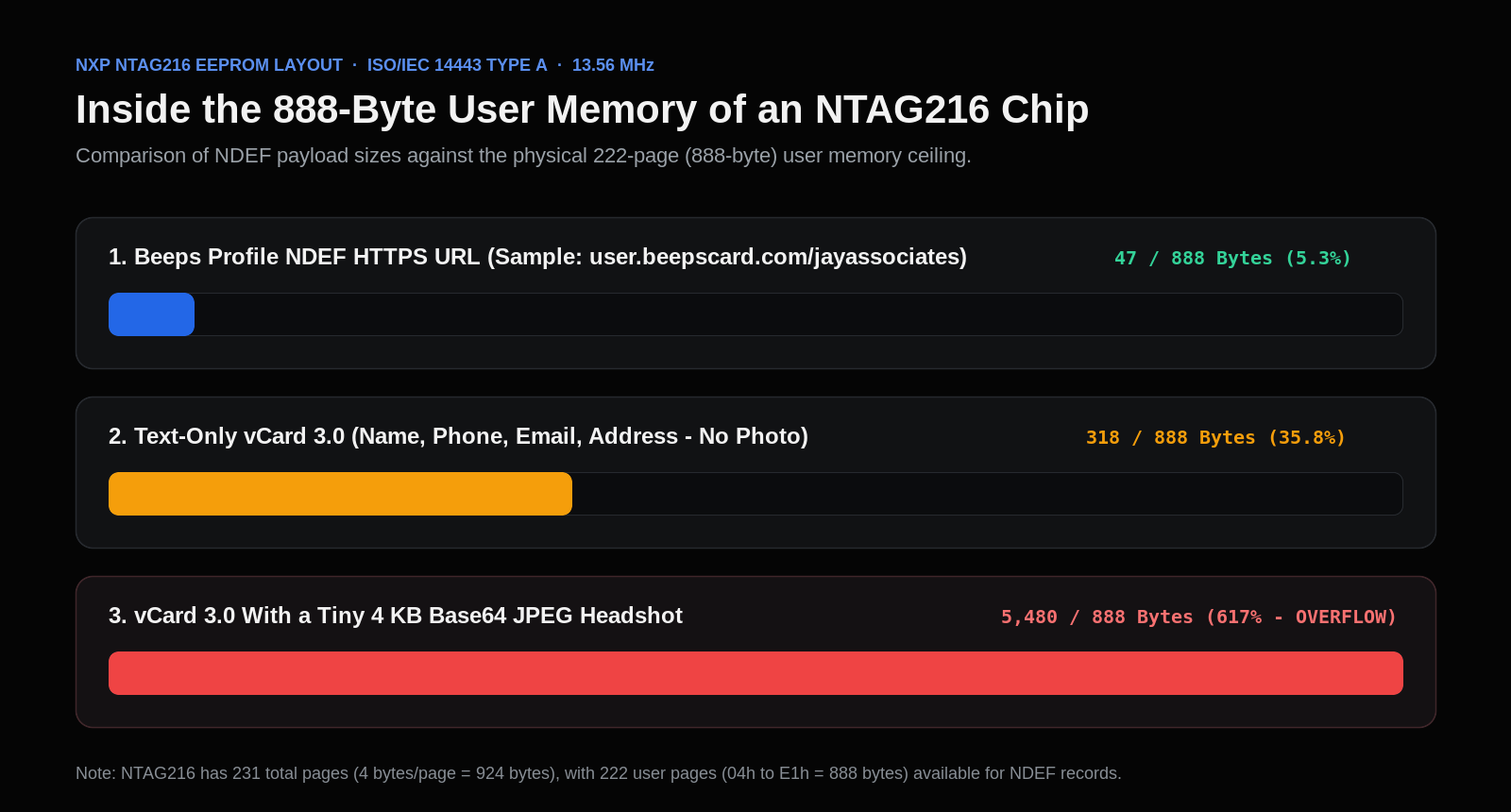
The short answer comes down to two hard technical rules in smartphone hardware and chip memory: first, Apple’s iOS Background Tag Reading engine ignores raw text/vcard records on NFC tags unless the phone owner manually opens a third-party scanner app first; second, an NXP NTAG216 chip has 888 bytes of user memory, while a single contact card carrying a tiny 4 KB headshot photo needs over 5,400 bytes.
Here is the exact byte-by-byte breakdown from the NXP NTAG216 datasheet and Apple’s Core NFC specification, so you know what actually happens during the 20 milliseconds a card touches a phone.
An iPhone XS or newer will automatically pop up a notification banner on the lock screen or home screen when it reads an NDEF URI record (https://...), but it stays completely silent when tapped against a chip holding a raw NDEF text/vcard MIME record.
What Apple’s iOS Background Tag Reader Actually Accepts
On Android phones with NFC switched on, the operating system parses several NDEF (NFC Data Exchange Format) record types right from the home screen, including URI records and text/vcard MIME records. Apple built iOS differently.
According to Apple’s official Core NFC Background Tag Reading documentation (supported on iPhone XS, iPhone XR, and all newer models without opening an app), the background reader scans only for NDEF URI records and Universal Links whose URI scheme matches a short allow-list:
| NDEF Record Type on Chip | Payload Example (Sample) | Android Home Screen Tap | iPhone Background Tap (No App) |
|---|---|---|---|
NDEF URI (https://) |
https://user.beepscard.com/jayassociates |
Opens immediately in browser | Shows tap banner immediately |
NDEF URI (tel:) |
tel:+919000000000 |
Opens phone dialler | Shows call prompt banner |
NDEF URI (mailto:) |
mailto:jay@mail.com |
Opens email composer | Shows email prompt banner |
NDEF MIME (text/vcard) |
BEGIN:VCARD VERSION:3.0 ... |
Imports contact (text only) | Ignored (Nothing happens on screen) |
NDEF Plain Text (T) |
Jay JJ - +91 90000 00000 |
Shows plain text viewer | Ignored (Nothing happens on screen) |
When you hand your card to a client who uses an iPhone and your chip is programmed with a raw text/vcard record, the iPhone’s NFC coil powers the chip, sees that the record is not a supported URI, and drops the event silently. The client thinks your card is broken. Our guide on how NFC business cards work on iPhones covers where the iPhone antenna sits and how iOS handles that tap banner.
The 888-Byte Memory Limit of NXP NTAG216 NFC Chips
Every physical Beeps NFC business card uses an NXP NTAG216 integrated circuit operating at 13.56 MHz under the ISO/IEC 14443 Type A and NFC Forum Type 2 Tag standards. Among standard NTAG21x chips (NTAG213 with 144 bytes, NTAG215 with 504 bytes, and NTAG216 with 888 bytes), the NTAG216 has the largest user memory.
Even so, 888 bytes is a strict physical ceiling. According to the NXP NTAG216 product data sheet, the EEPROM is divided into 231 pages of 4 bytes each (924 bytes total):
- Pages
00hto03h(16 bytes): 7-byte factory UID, serial number, internal lock bytes, and the Capability Container (CC) that tells the phone this is an NFC Forum Type 2 tag. - Pages
04htoE1h(222 pages = 888 bytes): Available user memory for NDEF records. - Pages
E2htoE6h(20 bytes): Dynamic lock bytes, configuration pages, and 32-bit password / PACK protection.
Counting the Exact Bytes: NDEF URL vs Raw vCard
Let us count the exact bytes written to the chip using our standard sample persona, Jay JJ at Jay Associates (all details below are samples).
NDEF URI Record (Optimized Digital Profile Format)
In the NFC Forum URI Record Type Definition, the prefix https:// is compressed into a single identifier byte (0x04). That means only the characters after https:// are stored as ASCII bytes, wrapped in a 7-byte NDEF TLV header and terminator:
Sample Profile URL: https://user.beepscard.com/jayassociates

Byte Count Breakdown:
- NDEF TLV Wrapper + Record Header:   6 bytes
- URI Identifier Code (0x04 = https): 1 byte
- ASCII string ("user.beepscard.com/jayassociates"): 39 bytes
- Terminator TLV (0xFE):              1 byte
------------------------------------------------
Total Chip Memory Used:              47 bytes (5.3% of 888 bytes)
Remaining Free Space on NTAG216:    841 bytes
Raw Text-Only vCard 3.0 (Without Photo or Links)
BEGIN:VCARD
VERSION:3.0
N:JJ;Jay;;;
FN:Jay JJ (Sample)
ORG:Jay Associates
TITLE:Partner
TEL;TYPE=CELL:+919000000000
EMAIL:jay@mail.com
ADR;TYPE=WORK:;;Suite 204, Sample Arcade, Kakkanad;Kochi;Kerala;682037;India
URL:https://user.beepscard.com/jayassociates
END:VCARD

Total Chip Memory Used (with NDEF MIME header): ~318 bytes (35.8% of 888 bytes)
Raw vCard 3.0 with Embedded Photo (Exceeds Chip Capacity)
When you embed even a heavily compressed 120 by 120 pixel JPEG headshot (4,000 bytes raw) inside a .vcf file, the vCard standard encodes binary images in Base64, inflating the size by 33% to ~5,333 bytes plus headers:
Total Payload Size: ~5,480 bytes (617% of the 888-byte NTAG216 limit)
Result: Cannot physically fit on an NTAG213, NTAG215, or NTAG216 card.
Tap Speed: Why 47 Bytes Reads Instantly on Contactless Tap
At the ISO/IEC 14443 Type A base transfer rate of 106 kbit/s, the NXP NTAG216 uses the READ command to fetch 4 pages (16 bytes) at a time. Reading a 47-byte URL takes just 3 block reads after anti-collision – completing in roughly 15 to 20 milliseconds. Even a quick, brushing tap against the top of an iPhone or the back of an Android phone finishes the read cleanly.
When a chip is packed to the brim with 800+ bytes of text, the phone must complete 50+ sequential block reads while the card stays motionless inside the phone’s magnetic field. If the other person pulls their hand away a fraction of a second too early, the read fails partway through.
Combining Instant Tap-to-Open with 1-Tap Contact Saving
By storing a compact 47-byte HTTPS URL on the NTAG216 chip and serving the full profile from the cloud, you avoid both hardware walls:
- Every iPhone XS+ and NFC Android phone opens the tap with zero app installed.
- The “Save to Contacts” button on the profile page serves a complete
.vcffile over HTTPS – complete with your high-resolution photo, company logo, multiple phone numbers, and office map – which both iOS Safari and Android Chrome import in one tap. - You can edit your details anytime from your phone without needing physical access to the cards you handed out last month, and your virtual business card can also capture two-way leads, display your product catalogue, book appointments, or accept direct UPI payments.
Sources & Primary References
- Apple Developer Documentation – Core NFC: Adding Support for Background Tag Reading (Supported NDEF URI Schemes on iPhone XS and Later), checked 30 October 2026.
- NXP Semiconductors – NTAG213/215/216 NFC Forum Type 2 Tag Compliant IC With 144/504/888 Bytes User Memory Product Data Sheet, checked 30 October 2026.
- Internet Engineering Task Force (IETF) – RFC 6350: vCard Format Specification, checked 30 October 2026.
- Beeps Card Editorial Standards – How we test hardware specifications and use sample personas, checked 30 October 2026.

How to Write the One-Line Bio on Your Digital Visiting Card (With 24 Copy-Ready Examples by Profession)