India Post DIGIPIN Explained: Adding Exact 4m Doorstep Coordinates to Your Visiting Card
In this article
A standard 6-digit Indian PIN code covers the entire delivery area of a post office – often 15 to 30 square kilometres across thousands of buildings. When a client, patient, or courier tries to find a clinic entrance, a second-floor office, or a warehouse gate inside an industrial estate, the PIN code gets them to the neighbourhood and leaves the last 300 metres to phone calls and WhatsApp landmarks.
To solve this last-mile gap, the Department of Posts (Ministry of Communications, Government of India) developed DIGIPIN (Digital Postal Index Number) in collaboration with IIT Hyderabad and NRSC, ISRO. A DIGIPIN is a free, open-source 10-character alphanumeric code that points to a specific 3.8 m by 3.8 m square anywhere in India.
Below is a plain-English breakdown of how the 10-character DIGIPIN grid works under the hood, why four common characters are left out of its alphabet, and how to list your exact doorstep code alongside your Google Maps pin on a digital visiting card.
DIGIPIN does not replace your 6-digit postal PIN code. Your 6-digit PIN routes mail to your local post office; your 10-character DIGIPIN marks the exact 3.8 m x 3.8 m square of your front door using latitude and longitude (WGS84 / EPSG:4326). Because the math is public domain, anyone can convert a DIGIPIN to GPS coordinates offline with zero API fees.
How the 10-Character DIGIPIN Grid Divides India to 3.8 Metres
Unlike private addressing apps that assign random words to squares on a proprietary server, DIGIPIN uses a hierarchical grid published in the Department of Posts technical specification. It starts with a single bounding box covering the whole of India (including maritime territories):
- Latitude range:
2.5° Nto38.5° N(a span of 36 degrees) - Longitude range:
63.5° Eto99.5° E(a span of 36 degrees) - Coordinate reference system: WGS84 (
EPSG:4326)
At Level 1, that 36° by 36° square is divided into a 4 by 4 grid of 16 cells. Each cell is assigned one character from a 16-symbol alphabet. At Level 2, the chosen cell is again split into a 4 by 4 grid of 16 smaller cells, adding the second character. Repeating that 4 by 4 split ten times narrows the box from 1,000 kilometres across down to under 4 metres across.
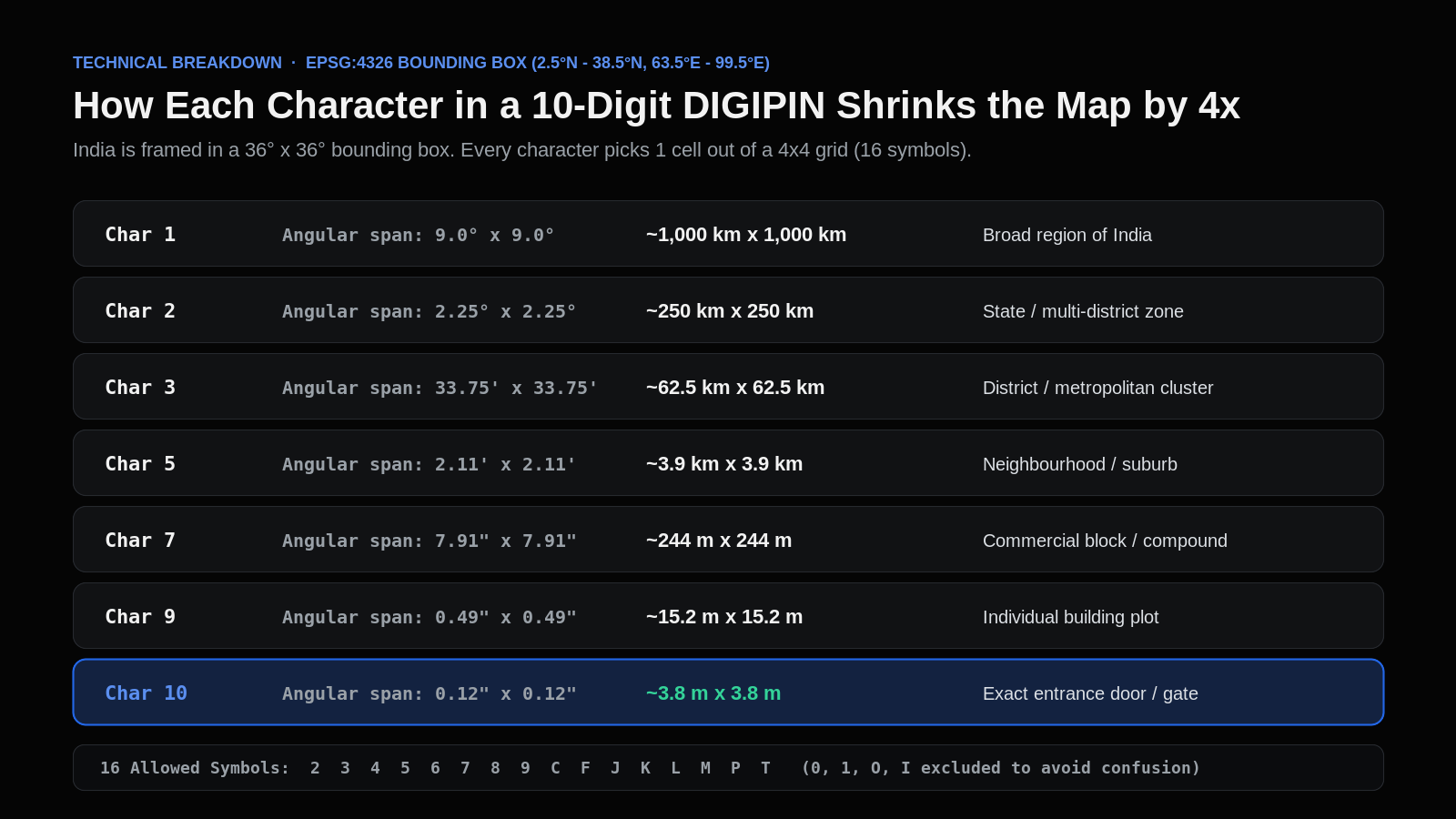
| DIGIPIN Level | Characters Used | Grid Span (Lat x Lon) | Approx. Ground Size | What It Identifies |
|---|---|---|---|---|
| Level 1 | 1 character | 9.0° x 9.0° |
~1,000 km x 1,000 km | Broad region of India |
| Level 2 | 2 characters | 2.25° x 2.25° |
~250 km x 250 km | State or multi-district zone |
| Level 3 | 3 characters | 33.75' x 33.75' |
~62.5 km x 62.5 km | District or metro area |
| Level 5 | 5 characters | 2.11' x 2.11' |
~3.9 km x 3.9 km | Township or urban sector |
| Level 6 | 6 characters | 31.64" x 31.64" |
~976 m x 976 m | Roughly 1 sq km neighbourhood |
| Level 8 | 8 characters | 1.98" x 1.98" |
~61 m x 61 m | Commercial complex or campus block |
| Level 9 | 9 characters | 0.49" x 0.49" |
~15.2 m x 15.2 m | Individual building footprint |
| Level 10 | 10 characters | 0.12" x 0.12" |
~3.8 m x 3.8 m | Specific entrance door, shutter, or gate |
Why DIGIPIN Uses Only 16 Base Characters (Omitting 0, 1, O, and I)
Because each level splits a square into 16 cells (4 rows by 4 columns), the system needs 16 characters. If you used standard hexadecimal (0-9 and A-F), people reading a visiting card or shipping label aloud over a phone call would constantly mix up the number 0 with the letter O, the number 1 with the letter I, or the letters B and 8.
To prevent human transcription mistakes, the Department of Posts selected these exact 16 unambiguous symbols:
Allowed DIGIPIN Symbols (16):
Numbers (8):  2, 3, 4, 5, 6, 7, 8, 9
Letters (8):  C, F, J, K, L, M, P, T

Excluded to prevent reading errors:
0, 1, A, B, D, E, G, H, I, N, O, Q, R, S, U, V, W, X, Y, Z
Inside each 4 by 4 cell, the symbols are arranged in a continuous spiral pattern so that adjacent grid squares share similar prefixes. When written on a visiting card or invoice, a 10-character DIGIPIN is usually grouped with hyphens as XXX-XXX-XXXX (for example, sample code 4P3-8J9-C2K7) so it is easy to read at a glance.
Why Businesses Need Both a Google Maps Link and a Doorstep Code
A Google Maps business listing is essential for local discovery and customer reviews, and our guide on how to put your business location on a visiting card walks through setting up your map link properly. However, three practical problems still come up on the ground in India:
- Large commercial complexes and IT parks: A single plot in Kakkanad, Whitefield, or Andheri can hold four towers and three entry gates. A building-level map pin drops visitors at the centre of the plot rather than the visitor parking gate.
- Industrial estates and warehouses: A factory often has a front office entrance on one road and a dispatch bay 80 metres away on a service lane. Because each DIGIPIN square is 3.8 m by 3.8 m, the front reception and the loading shutter have two distinct 10-character codes.
- Offline and cross-app portability: Because DIGIPIN is a direct mathematical encoding of latitude and longitude published by the Government of India on GitHub, logistics companies, emergency services, and mapping tools can decode it directly into GPS coordinates without paying per-lookup map API fees.
Address Formatting Guide: Adding DIGIPIN to Your Visiting Card
You do not need a special plugin to display your DIGIPIN. Look up the 10-character code for your exact entrance door on India Post’s official Know Your DIGIPIN portal while standing at the threshold, and add it to the address line and custom link section of your digital visiting card.
Here is how we format it using our standard sample business, Jay JJ at Jay Associates (all details below are samples):
Business Name:   Jay Associates (Sample)
Contact Person:  Jay JJ
Phone / WhatsApp: +91 90000 00000 (Sample)
Email:           jay@mail.com (Sample)
Postal Address:  Suite 204, 2nd Floor, Sample Arcade,
                 Kakkanad, Kochi, Kerala - 682037
Doorstep DIGIPIN: 4P3-8J9-C2K7 (Sample - Main Reception Entrance)
Digital Card:    https://user.beepscard.com/jayassociates
If your business has both a customer entrance and a goods delivery gate, list both clearly in your profile description or enquiry instructions:
- Visitor & Client Entrance:
4P3-8J9-C2K7(Sample – East Gate near Reception) - Courier & Dispatch Bay:
4P3-8J9-C2M4(Sample – Rear Service Lane)
When someone taps your NFC business card or scans your counter QR code, they get your 1-tap Google Maps button for turn-by-turn navigation, your written street address for billing records, and your 10-character DIGIPIN for exact doorstep arrival.
Sources & Primary References
- Department of Posts, Ministry of Communications, Government of India – National Addressing Grid (DIGIPIN) Official Portal and Technical Documentation, checked 30 October 2026.
- Department of Posts & IIT Hyderabad – Know Your DIGIPIN Web Application (EPSG:4326 10-Character Grid Lookup), checked 30 October 2026.
- Press Information Bureau (PIB), Government of India – Department of Posts launches DIGIPIN – Digital Postal Index Number for geo-coded addressing in India, checked 30 October 2026.
- Beeps Card Editorial Standards – How we verify regulations, technical specifications, and sample personas, checked 30 October 2026.

How to Write the One-Line Bio on Your Digital Visiting Card (With 24 Copy-Ready Examples by Profession)